



They also inspire pupils to look at apparel more critically. Students are not only saying whether or not they like a clothing, they are beginning to comprehend why its proportions, colors, structure or details make it visually successful.
It takes practice to develop these talents. Through repeated drawing, experimenting, and design tasks, students develop their capacity to articulate ideas.
In time the sketchbook might become a vital document of their fashion designing course in Jaipur creative growth.
Textiles, Fabrics & Design Heritage of Jaipur Explore
The fashion designer has to have fabric as the main thing in the design process. varying materials have varying weights, textures, drapes, stretches, finishes and construction needs. Understanding these aspects helps designers to make much better choices in garment design.
Students will learn about several types of textiles, including natural and synthetic, mixes, woven and knitted, and specialized textiles. Jaipur and the surrounding Rajasthan area is especially rich in textile discovery. Traditional crafts and methods may expose pupils to centuries of creative expertise. Contemporary design study might start with patterns, motifs, colors, needlework, printing processes and handmade elements.
It’s not always about a perfect reproduction of traditional clothes. Students may examine how historical inspirations might be applied to contemporary shapes, lifestyles and customer desires. A classic design might be the inspiration for a contemporary print, an established needlework method can be adapted to a current garment.
This method encourages designers to conceive of fashion as a dialog between the past and the present. Cultural allusions may provide depth to a collection and the modern construction and style ensure the finished clothes are relevant to today’s consumers.
Textile education may also expose students to ethical design techniques. Knowledge of material usage, fabric waste, durability, manufacturing procedures, and garment lifetime may result in more conscious decisions. As the fashion business continues to talk about sustainability, understanding of materials may become more and more important.
Pattern Making & Garment Construction Experiences
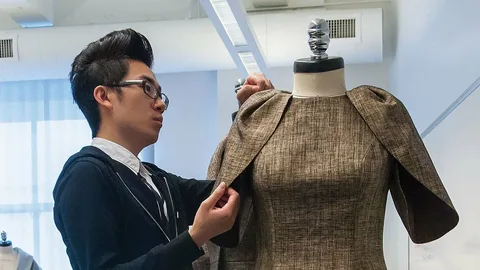
Technical execution is what turns creative concepts into actual clothes. Pattern creation and garment fabrication are therefore key components of fashion education. They educate students to take two-dimensional ideas and translate them into three-dimensional garments.
Pattern creation is the process of creating templates for the structure and form of a garment. Students learn about dimensions, seam allowances, darts, panels, pleats, closures and other parts of construction. These ideas assist designers know how the many sections of a garment fit together.
The fabrication of a garment gives you practical experience. Students learn the methods of cutting, sewing, finishing, pressing and assembly while working with diverse materials. Practical practice helps students to learn the characteristics of textiles throughout fabrication.
Fitting is a big part of the procedure as well. A design that seems excellent on paper could need some tweaking when made in fabric. Students learn to detect difficulties with length, movement, proportion and fit and make the appropriate changes.
Technical expertise also enables designers to interact with manufacturing personnel. Even if a designer finally uses expert pattern makers or garment manufacturers, knowing construction means they can express their ideas better.
Practical garment development teaches problem resolution. Sometimes a certain cloth doesn’t behave the way you want it to or a silhouette has to be structurally altered. Students learn to assess the situation, test alternatives and adapt their strategy.
Fashion design is a practical career because of the mix of technical expertise and creativeness. It’s crucial to be able to conceive a garment, but it’s also important to understand how to make that garment possible.
Designing a Full Collection of Fashion
Taking an initial idea and building it into a collection is one of the most satisfying things about a fashion school. The approach enables students to integrate research, design, fabrics, building, style and presentation.
Typically a collection starts with a primary subject or source of inspiration. Designing a collection is more than just designing a few beautiful pieces. The parts have to fit together, yet still be varied enough to be fascinating. The clothing might be linked by recurring colors, textures, themes, shapes or construction characteristics.
Sampling is a significant feature of this step. Students may make test pieces to play with fabrics, dimensions, decorations and construction methods. Some concepts will evolve considerably as part of the typical design development process.
Then you may dress up the final collection with fits and styling. Students evaluate how clothing will be displayed, what accessories will go with them and how the visual narrative as a whole should be told.
Collection development also provides lessons on project management. Students have to manage their time, organize supplies, fulfill deadlines and coordinate the numerous phases of production. These behaviors may be helpful when you work on professional fashion projects.
A finished collection may also be a significant aspect of a student’s portfolio. It shows the ability to take a concept from research, to final clothing and presentation.
Learning Digital Skills and Understanding the Fashion Industry
Fashion is becoming more and more intertwined with technology and today’s designers may benefit from knowing about digital instruments.
It is not just design that students may study, but also the business aspect of fashion. The industry includes designers, manufacturers, merchants, merchandisers, marketers, stylists, photographers, buyers and many more. Understanding the interplay of these jobs helps offer a fuller picture of the fashion ecology.
Another area where consumer research is useful. The fashion merchandising teaches the pupils about the product selection, market trends, retail presentation and customer behavior. Fashion communication may look into the marketing of collections via photography, social media, editorial content, events and other channels.
Career Paths in Fashion Education
There are several employment opportunities you may explore with a fashion designing training. Fashion is more than just designing clothes. It provides opportunity for those with a whole range of creative and technical interests.
Fashion designers may produce collections for well known firms, independent labels, boutiques or specialized markets. Some designers specialize in women’s clothing, men’s wear, children’s wear, event wear, activewear or other areas.
Textile designers deal with color, pattern, print, embroidery and other surface finishes. Their designs may be adapted for use in garments, accessories, home textiles or other uses.
Fashion stylists put together clothes, accessories, haircuts and more into whole visual ensembles. You’ll find their work in editorial photography, advertising, entertainment, events and digital media.
Fashion illustrators are communicators of the visual. They may be used for design portfolios, journalistic projects, advertising, presentations and creative campaigns.
Summary
Understanding these fashion designing course in Jaipur topics may help students comprehend fashion as a creative and a commercial sector. In a professional context, for a good garment to exist, it has to have a defined audience, a feasible production plan, and successful communication.
