



Morocco is a country where history, culture, and natural beauty merge into a vivid tapestry of experiences. From the labyrinthine souks of ancient cities to the golden silence of sweeping dunes, every region offers something unique. A carefully curated 5-day tour starting from Marrakech offers three distinct experiences: the Sahara Desert, the Imperial Cities, and the dramatic landscapes that connect them. This journey is not merely a trip across distance, but a passage through centuries of history, diverse cultures, and breathtaking scenery.
Day 1: Marrakech – The Red City’s Living Heritage
The adventure begins in Marrakech, often called the “Red City” because of its distinctive rose-colored walls and buildings. Founded in the 11th century by the Almoravid dynasty, Marrakech has long been a political, economic, and cultural center of Morocco.
A walk through Jemaa el-Fnaa introduces travelers to the city’s vibrant rhythm. By day, snake charmers, herbalists, and street vendors fill the square; by night, it transforms into a vast open-air dining hall. Nearby stands the majestic Koutoubia Mosque, whose 12th-century minaret dominates the skyline and serves as an architectural benchmark for Moroccan-Andalusian design.
Exploring the medina’s narrow alleys reveals artisanal workshops, spice markets, and traditional riads hidden behind modest doors. Gardens such as Majorelle Garden offer tranquility, contrasting with the bustling souks. The first day provides a cultural immersion that sets the tone for the journey ahead.
Day 2: Crossing the Atlas Mountains – Gateway to the Desert
Leaving Marrakech, the tour ascends into the High Atlas Mountains via the spectacular Tizi n’Tichka pass. Winding roads climb to over 2,200 meters above sea level, offering panoramic views of rugged peaks and Berber villages perched along steep slopes.
One of the highlights of this leg is the UNESCO World Heritage Site Aït Benhaddou, a fortified village (ksar) built from earthen clay. This ancient settlement has served as a backdrop for numerous films and remains a testament to traditional Saharan architecture. Walking through its narrow passages feels like stepping into a bygone era of caravan trade and desert commerce.
Further along lies Ouarzazate, often referred to as the “Gateway to the Sahara.” Historically an important stop for traders heading south, it now blends cinematic fame with cultural heritage. The transition from lush valleys to arid plains marks the beginning of the desert experience.
Day 3: The Sahara Desert – An Ocean of Sand
No 5-day tour starting from Marrakech would be complete without entering the magnificent Sahara Desert. As the road approaches Merzouga, vast dunes begin to dominate the horizon. Here lie the famous Erg Chebbi dunes, some rising over 150 meters high.
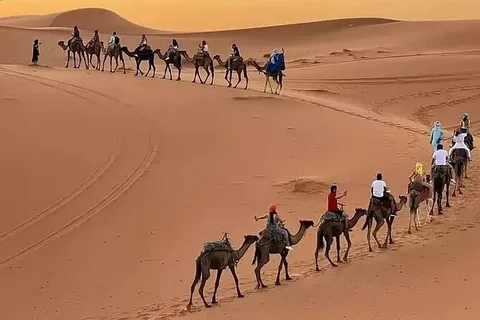
A camel trek at sunset is one of the most iconic desert experiences. As the caravan moves rhythmically across the golden sand, the changing light transforms the landscape into shades of amber and crimson. The silence of the desert is profound, broken only by the soft steps of camels and the whisper of wind.
Night in a traditional desert camp offers a deeper connection to the environment. Beneath a sky scattered with countless stars, visitors gather around a campfire, listening to Berber music and stories. The Sahara is not merely a geographical location; it is a space of introspection, simplicity, and timeless beauty.
Day 4: Journey Toward the Imperial Cities
Departing the desert, the journey continues northward through the scenic Ziz Valley, known for its lush palm groves and dramatic gorges. Passing through Midelt, travelers witness the transition from desert landscapes to fertile plains.
A surprising contrast appears in Ifrane, often nicknamed “Little Switzerland” for its alpine-style architecture and cool climate. Nearby cedar forests, particularly around Azrou, are home to Barbary macaques. This segment of the tour demonstrates Morocco’s ecological diversity within a relatively short distance.
As the route approaches the historic urban centers, the emphasis shifts from natural grandeur to architectural and political legacy.
Day 5: Exploring the Imperial Cities – Fez and Rabat
The final phase of this 5-day tour focuses on Morocco’s legendary Imperial Cities, beginning with Fez. Founded in the 9th century, Fez is widely regarded as the spiritual and intellectual heart of the country. Its medina, a UNESCO World Heritage Site, is one of the largest car-free urban areas in the world. Within its maze-like alleys stands University of Al Quaraouiyine, recognized as one of the oldest continuously operating educational institutions globally.
Fez offers a sensory journey—vibrant tanneries, intricate zellige tilework, and the call to prayer echoing through ancient walls. Every corner tells a story of dynasties, scholars, and craftsmen who shaped Moroccan civilization.
Continuing westward, the tour reaches Rabat, the modern capital and another of the Imperial Cities. Here, historical monuments such as the Hassan Tower stand alongside contemporary boulevards and governmental institutions. Rabat’s calmer atmosphere contrasts with Fez’s intensity, offering a refined conclusion to the journey.
Three Distinct Experiences in One Journey
What makes a 5-day tour starting from Marrakech particularly compelling is its diversity within a compact itinerary. Each segment delivers a different dimension of Morocco:
- Cultural Immersion in Marrakech – A vibrant introduction to Moroccan life, architecture, and cuisine.
- The Sublime Vastness of the Sahara Desert – A spiritual and natural experience defined by silence, scale, and simplicity.
- Historical Depth in the Imperial Cities – A journey through dynastic power, religious scholarship, and artistic achievement.
The seamless progression from bustling markets to tranquil dunes and finally to monumental cities creates a narrative arc. Travelers begin in the energetic present, move through timeless nature, and conclude in the enduring legacy of Morocco’s imperial heritage.
Why This Tour Is Ideal
A five-day itinerary strikes a practical balance. It allows enough time to cover long distances without feeling rushed, while remaining accessible for travelers with limited vacation schedules. The route is carefully structured to minimize backtracking and maximize experiential contrast.
Moreover, this journey highlights Morocco’s geographical diversity—mountain ranges, desert expanses, fertile valleys, and coastal plains. It also showcases architectural diversity, from earthen kasbahs and Islamic minarets to European-influenced civic structures.
Conclusion
In essence, a 5-day tour starting from Marrakech offers three distinct experiences: the Sahara Desert, the Imperial Cities, and the breathtaking landscapes that connect them. It is an expedition through space and time—across shifting dunes, ancient medinas, and mountain passes carved by history.
For travelers seeking cultural depth, natural wonder, and historical richness in a single itinerary, this tour encapsulates the very spirit of Morocco. Whether watching the sun set over Erg Chebbi, listening to storytellers in Jemaa el-Fnaa, or wandering through the scholarly corridors of Fez, each moment contributes to a journey that is as diverse as it is unforgettable.
