



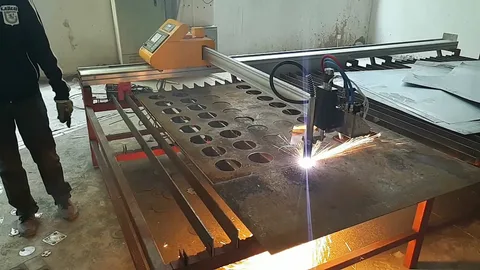
Across steel yards and fabrication floors, structural components start as raw plate and transform into beams, gussets, and connection points that hold buildings together. The speed and precision of a CNC plasma cutter make it a preferred tool for shaping these heavy materials. Teams working with large steel members depend on equipment that keeps production moving while maintaining the accuracy their projects demand.
Cuts Thick Steel Plates Fast Without Extensive Setup
Thick plate steel requires a cutting method that delivers power without slowing production. A CNC plasma cutting machine creates high-temperature arcs that melt through heavy material quickly, allowing fabricators to produce large components in less time than many traditional methods. This rapid penetration is especially valuable when handling repetitive parts for structural frames. Setup efficiency also drives preference for plasma. Unlike some mechanical processes that require clamping or tool changes, a plasma cutter moves from one job to the next with minimal downtime. Operators simply load the material, confirm the program, and begin cutting, making the workflow steady and predictable.
Handles Irregular Shapes with Precise, Repeatable Motion
Structural steel designs often include curved profiles, slot cutouts, or angled edges. A CNC plasma cutter follows digital paths precisely, creating shapes that match engineering drawings without manual tracing or positioning. This consistency ensures that every part fits during assembly, reducing rework. Repeatability becomes even more important on large construction projects where hundreds of identical components must match. The CNC table motion system controls speed, direction, and height to maintain accuracy across every cut. CNC companies near me frequently recommend plasma for shops that need predictable results across varied geometries.
Produces Clean Edges Ready for Welding or Finishing
Structural components must join cleanly to ensure strong welds. Plasma cutting produces smooth, uniform edges with minimal dross, which reduces grinding and prep work. The cleaner the edge, the easier it is for welders to maintain penetration and alignment.
This edge quality also benefits finishing processes like painting or galvanizing. Rough or uneven edges can trap coating material or create inconsistencies. With a CNC plasma cutting machine, the resulting parts move into the next stage with less manual intervention.
Works Well on Heavy Gauge Steel Used in Structural Frames
Structural frames rely on heavy-gauge steel to support loads safely. Plasma cutting excels in this thickness range, delivering power that maintains straight, accurate cuts even on dense material. The arc remains stable throughout long runs, preventing wander and distortion. This capability is especially useful for fabricating columns, stiffeners, and load-bearing plates. A plasma cutter maintains control across the entire cutting path, ensuring that dimension-critical parts meet the engineering requirements set for large structures.
Supports High Production Rates with Automated Table Control
Large structural projects depend on throughput. Automated CNC tables allow plasma systems to run multiple parts in sequence without stopping, dramatically improving output. Programs can nest shapes closely to maximize material usage while maintaining tight accuracy. Automation also frees operators to prepare upcoming jobs while the current job runs. CNC machine company experts design software interfaces that streamline file loading and part sequencing, keeping production efficient throughout long shifts.
Reduces Manual Labor Compared to Oxy-fuel Cutting Methods
Oxy-fuel cutting has been used for decades, but it often requires more operator skill and more post-cut cleanup. Plasma technology reduces manual effort by cutting faster, cleaner, and with less heat spread. This limits the need for extensive grinding or rework.
Operators appreciate the reduced physical strain and shorter learning curve. A CNC plasma cutter performs most of the work automatically once programmed, shifting labor toward oversight rather than continuous hands-on cutting.
Adapts Easily to Changes in Part Layout or Design Files
Construction projects frequently update drawings or adjust part dimensions during planning. Plasma systems adapt quickly to these changes because design files can be edited and reloaded with minimal effort. There is no need to create new templates or jigs.
Digital flexibility reduces delays and supports real-time project adjustments. CNC companies near me often highlight this adaptability as a key advantage for structural steel shops that must respond to shifting project demands.
Maintains Accuracy Across Long, Straight Cuts and Curves
Beam plates, baseplates, and long braces require cuts that stay straight from start to finish. Plasma cutting systems maintain accuracy over extended travel distances, ensuring that parts remain true to the engineered dimensions. Even slight deviations can cause fitment issues, so precision is essential.
Curved components receive equal attention. With guided torch motion and proper height control, a CNC plasma cutting machine produces arcs and radii that align perfectly with CAD models. This consistency supports efficient assembly and dependable load distribution.
Minimizes Heat Distortion on Large Structural Members
Heat distortion can compromise structural integrity. Plasma cutting focuses heat into a narrow stream, reducing the heat-affected zone and limiting warping on large pieces. This makes it easier to assemble beams and plates accurately on-site or in the shop.
Reduced distortion also minimizes corrective processes. Straightening or heat-treating large plates adds cost and time. Plasma’s controlled heat input keeps components stable, reducing extra steps after cutting. Structural steel fabrication benefits from the strength, speed, and accuracy that plasma technology delivers. Amtec Solutions Group provides CNC plasma systems and automation solutions that help steel shops improve throughput, reduce labor demands, and maintain reliable cut quality across demanding structural applications.
