



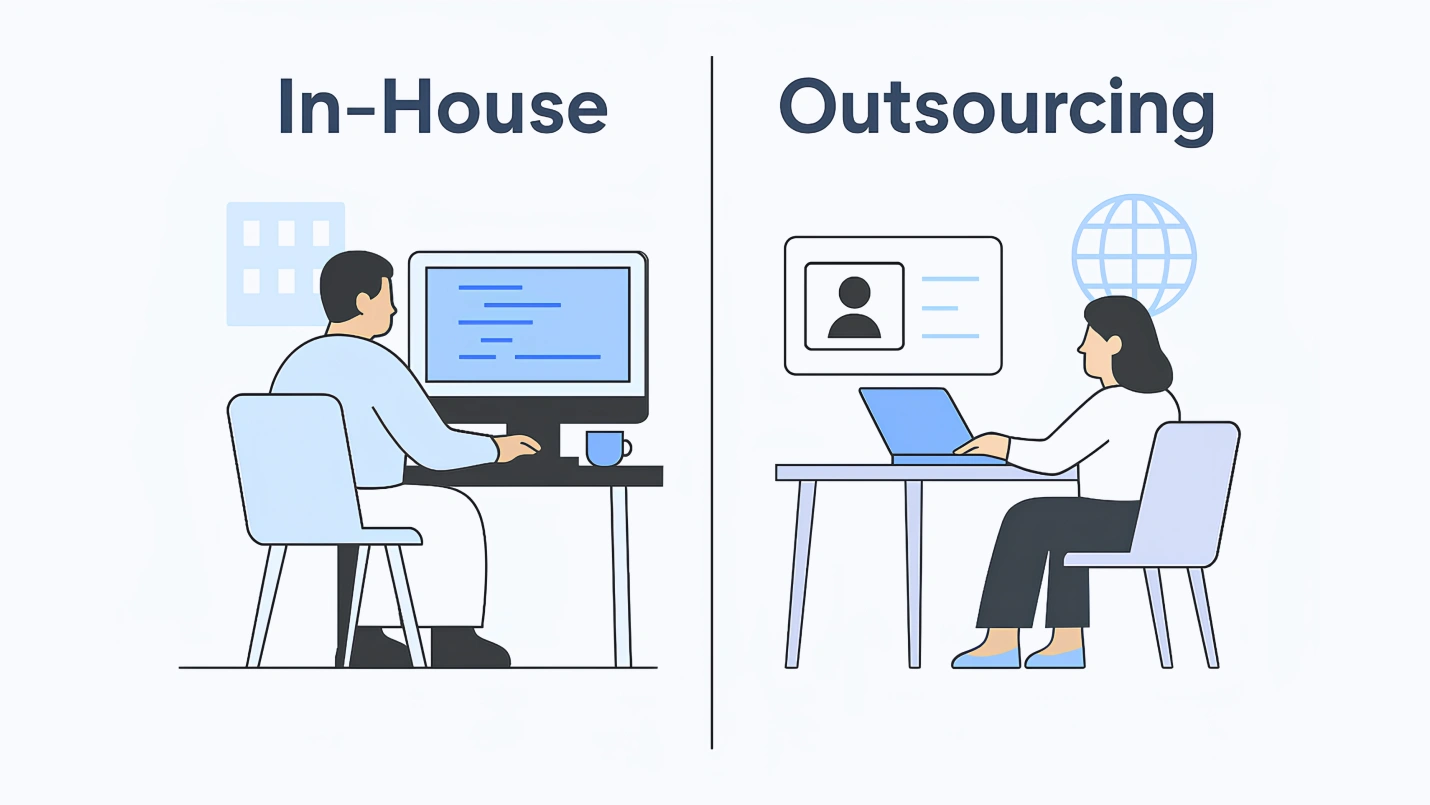
Building a mobile app is a significant business decision. Companies must consider product strategy, design, development, testing, security, maintenance, and the resources required to support the application after launch. While some organizations prefer to build everything internally, outsourcing can be a practical alternative when specialized skills, speed, or additional development capacity are needed.
Research into current outsourcing practices shows that companies commonly outsource when they lack mobile expertise, need to accelerate an MVP, require additional capacity, or need specialized technologies without hiring a permanent team.
Table of Contents
ToggleWhat Does Outsourcing Mobile App Development Mean?
Outsourcing mobile app development means hiring an external development company, agency, or dedicated team to handle some or all aspects of an application. The outsourced team may be responsible for planning, UI/UX design, coding, testing, deployment, and ongoing maintenance.
A business does not necessarily have to outsource the entire project. For example, an internal team might manage the product strategy and backend while an external team develops the iOS and Android applications. This flexible approach allows companies to maintain control while filling important technical gaps.
When You Do Not Have an In-House Mobile Team
One of the clearest reasons to outsource is the absence of experienced mobile developers. Building a professional app can require knowledge of iOS, Android, cross-platform frameworks, APIs, cloud infrastructure, security, testing, and deployment.
Hiring several specialists for a single project can take considerable time and create long-term employment costs. An experienced external team can provide the required skills without requiring the company to build an entire mobile department from scratch.
When You Need to Launch Quickly
Timing can be critical for startups and businesses entering competitive markets. If hiring, training, and building an internal team would delay the product significantly, outsourcing may provide a faster path to development.
Established development partners already have developers, designers, testers, project managers, and established workflows. This can make it easier to move from planning to development without spending months assembling a team.
When Your Internal Team Is Already Overloaded
A company may have excellent developers and still benefit from outsourcing. Internal teams often have existing responsibilities such as maintaining websites, managing databases, improving existing software, or developing core business systems.
Adding a major mobile application to their workload can create delays and burnout. Outsourcing allows internal employees to remain focused on their most important responsibilities while an external team handles the mobile project.
When You Need Specialized Technical Expertise
Some applications require skills that a company’s existing developers may not possess. Examples include artificial intelligence, augmented reality, Internet of Things integrations, advanced mobile security, real-time communication, complex payment systems, and sophisticated location-based features.
Hiring permanent specialists for a single project may not make financial sense. Outsourcing gives businesses access to specialized expertise when it is actually needed.
When You Are Building an MVP
Startups often do not know how customers will respond to a new application. Building a large internal development department before validating the concept can be risky.
Outsourcing can be useful for creating a minimum viable product with essential features, launching it, collecting user feedback, and determining whether additional investment is justified. Once the product demonstrates demand, the business can decide whether to continue outsourcing, build an internal team, or use a hybrid approach.
When You Need Both iOS and Android Development
Supporting multiple mobile platforms can increase development requirements. Native iOS and Android development may require different technical expertise, while cross-platform frameworks can introduce their own architectural and testing considerations.
An experienced outsourcing partner may already have specialists across multiple platforms. This can make it easier to plan a coordinated release rather than attempting to build separate capabilities internally.
When You Need Flexible Development Capacity
Not every company needs the same number of developers throughout the year. A project may require a larger team during initial development and a smaller team for maintenance after launch.
Outsourcing provides greater flexibility because businesses can increase or decrease development resources according to project requirements. Dedicated teams and staff-augmentation models can be particularly useful when an organization already has technical leadership but needs additional engineering capacity.
When You Want to Control Long-Term Hiring Costs
Creating an internal mobile department involves more than developer salaries. Businesses may also need to account for recruitment, onboarding, benefits, software tools, equipment, management, training, and ongoing professional development.
Outsourcing changes the cost structure by allowing the company to purchase development capacity based on its requirements. However, cost should not be the only consideration. Quality, communication, security, technical expertise, and long-term maintainability can have a greater impact on the overall value of the project.
When Your Business Needs to Focus on Its Core Operations
Business owners and internal teams should not have to spend all their time managing technical development. If the company’s competitive advantage lies in healthcare, retail, finance, logistics, education, hospitality, or another specialized industry, internal employees may be better focused on customers and business strategy.
A reliable development partner can handle technical execution while the business retains ownership of its vision, priorities, branding, and customer experience.
When Outsourcing May Not Be the Best Choice
Outsourcing is not automatically the right solution. Keeping development in-house may be more appropriate when the application contains extremely sensitive intellectual property, when deep internal domain knowledge is essential, or when a company already has a strong mobile engineering team with sufficient capacity.
Companies should also think carefully about communication and project management. An outsourced relationship requires clear requirements, regular communication, appropriate documentation, and clearly defined responsibilities.
Full Outsourcing vs. Partial Outsourcing
Businesses do not have to choose between completely internal development and completely outsourced development.
Full outsourcing can work well when a company lacks an internal mobile team and wants an external partner to manage design, development, testing, deployment, and maintenance.
Partial outsourcing can be better when the company already has developers but needs assistance with particular areas such as UI design, QA testing, iOS development, Android development, or cloud integration.
Staff augmentation is another option. In this model, external developers become an extension of the existing team while internal managers retain greater control over daily development decisions.
How to Know You Are Ready to Outsource
Before contacting a development company, define the business objective, target users, essential features, preferred platforms, approximate timeline, and available budget. It is also useful to determine who inside the organization will make product decisions and communicate with the external team.
A strong outsourcing arrangement should provide clear ownership of intellectual property, transparent deliverables, quality assurance procedures, security expectations, communication schedules, and post-launch support.
Choosing the Right Outsourcing Partner
Do not select a development company based only on the lowest quoted price. Examine its experience with applications similar to yours, technical capabilities, development methodology, testing practices, communication process, security procedures, and maintenance options.
Ask how the company handles changing requirements, bug fixes, app-store releases, source-code ownership, documentation, and transition if the partnership eventually ends. These details can have a major effect on the long-term success of the application.
The Role of Mobile App Development Services
The right mobile app development services should support more than writing code. Depending on the project, they may include discovery, product planning, UI/UX design, native or cross-platform development, backend integration, quality assurance, deployment, analytics, maintenance, and future improvements. A business should select the scope of services according to its internal capabilities rather than automatically outsourcing everything.
Final Thoughts
The best time to outsource mobile app development is when an external team can provide something the business currently lacks—whether that is specialized expertise, faster delivery, additional capacity, multi-platform experience, or flexible resources.
Outsourcing is particularly attractive when there is no dedicated mobile team, the internal developers are overloaded, an MVP needs to reach users quickly, or specialized technology is required. At the same time, companies with strong internal expertise and highly sensitive proprietary technology may benefit from keeping more development in-house.
Ultimately, outsourcing should be treated as a strategic decision rather than simply a way to reduce development costs. With clear goals, strong communication, appropriate project ownership, and a carefully selected partner, an external development team can become a valuable extension of the business.
