



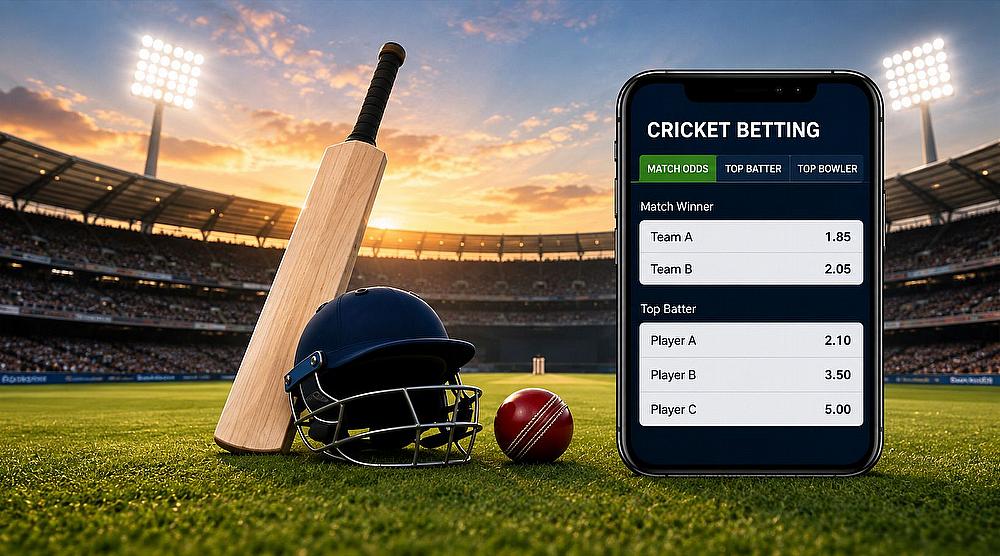
Cricket has a wide range of betting markets, and understanding the terminology is an important first step for anyone researching how cricket wagering works. Unlike simply predicting which team will win, cricket markets can focus on runs, wickets, players, overs, innings, partnerships, and specific events.
This guide explains common cricket betting markets and the terminology associated with them in straightforward language. It focuses on understanding how markets are structured rather than suggesting that any particular wager will be profitable.
What Is a Cricket Betting Market?
A betting market is a specific question about a cricket match or tournament. For example, a market might ask which team will win, whether an innings will produce more or fewer runs than a particular line, or which player will score the most runs.
The important thing is to identify what is being measured, the relevant time period, and the condition required for settlement. A team-total market, for example, measures one team’s runs, while a match-total market may combine the scores of both teams.
Match Winner Market
The match-winner market is one of the easiest cricket markets to understand. The selection is based on which team wins according to the applicable competition and market rules.
In limited-overs cricket, the market may have two primary outcomes, while Test cricket can involve a draw. Different competitions and platforms can also have specific rules for tied matches, Super Overs, or abandoned games.
Understanding the competition format is therefore important before interpreting a match-winner market.
Over and Under Markets
Over/under markets involve a numerical line. Instead of predicting the winner, the participant predicts whether a statistic will finish above or below that line.
For example, if a team-total line is 165.5 runs, an over selection requires at least 166 runs, while an under selection covers 165 or fewer. The same basic concept can be applied to runs, wickets, sixes, boundaries, or player statistics.
Half-number lines are commonly used because they prevent the exact line from producing a straightforward tie.
Team Total Runs
A team-total market focuses exclusively on the score of one team.
Suppose a team has a total-runs line of 250.5. The market is concerned with whether that particular team reaches at least 251 runs or remains below the threshold. The opponent’s score does not directly determine the settlement of that team-total market.
This is different from a combined match-total market, where runs from both teams can be relevant.
Match Total Runs
A match-total market considers the combined runs specified by the market. In a standard limited-overs example, this could mean adding the runs scored by both teams.
The market might present a line such as 500.5 runs and ask whether the combined total will finish over or under that number. However, the exact definition should always be checked because settlement conditions can vary between competitions and platforms.
Run Handicap or Spread
A handicap changes the effective score for market purposes.
For example, a team might be listed with a -20.5 run handicap. In a simplified example, that team would need to win by more than 20 runs for the handicap selection to succeed.
Some cricket handicap markets use wickets instead of runs. These should not be treated as identical because the settlement calculations are different.
Player Performance Markets
Player markets focus on individual performances rather than the overall match result. Common examples include:
- Player runs
- Player wickets
- Player sixes
- Player boundaries
- Player catches
- Combined player statistics
A player-runs market might establish a numerical line and ask whether the batter scores over or under it. Player markets can have additional conditions concerning whether the player starts, bats, bowls, or participates in enough of the match for the market to stand.
Top Batter and Top Bowler Markets
A top batter market generally asks which specified player will score the most runs within the defined team or competition.
A top bowler market similarly focuses on wicket-taking performance. The precise market description matters because a top-batter market for one team is different from a market covering every player in the match.
Dead-heat rules can also become relevant when two or more players finish with the same qualifying statistic.
Powerplay Markets
Powerplay markets focus on a particular period of an innings. In limited-overs cricket, this commonly means the opening overs during which fielding restrictions apply.
A market might ask whether a team scores above or below a specified number of runs during the powerplay.
Because the market only covers a defined section of the innings, it should not be confused with the team’s eventual innings total.
Session Markets
A session market covers a specified block of overs or period of play. For example, a market could focus on runs scored during the first six overs.
The central terms are session, line, over, and under. The exact number of overs included and the settlement conditions should be checked before interpreting the market.
Session markets can be particularly sensitive to early wickets, boundaries, bowling changes, and weather interruptions.
First Innings and Innings Markets
An innings market focuses on a particular innings rather than the entire match.
For example, a market could concern the total runs scored during a team’s first innings. This distinction becomes especially important in Test cricket, where teams can have multiple innings.
Always check whether a market refers to the first innings, second innings, a particular team’s innings, or the entire match.
Fall of Wicket Markets
A fall-of-wicket market concerns the score or timing at which the next wicket falls.
Depending on the market, the relevant measurement could involve the team’s score or the number of overs completed. These markets therefore require careful attention to exactly what the displayed line represents.
Toss Winner
A toss-winner market concerns which captain or team wins the pre-match coin toss.
The toss itself does not determine the match result. It only determines which team wins the choice associated with the toss under the competition’s playing conditions.
Because it is a random event, it should not be confused with markets based on team performance.
Live or In-Play Betting
Live betting, also called in-play betting, takes place after a match has started.
Prices can change as the match develops. A wicket, boundary, change in required run rate, injury, or weather interruption can alter the available markets and prices.
Cricket is particularly dynamic because the value of a situation can change significantly within a single over. Some markets may also be suspended temporarily while an important event is taking place.
Understanding Cricket Betting Odds
Odds communicate the potential return associated with a selection and provide an indication of the price assigned to an outcome.
With decimal odds, the total return is calculated by multiplying the stake by the decimal price. For example, a one-unit stake at decimal odds of 2.50 would produce a 2.50-unit total return if the selection wins, including the original stake.
The basic implied-probability calculation for decimal odds is:
Implied probability = 1 ÷ decimal odds
At 2.50, this equals 40%. However, implied probability should not automatically be interpreted as the actual probability of an event occurring because betting prices generally incorporate a margin.
Stake, Return, and Profit
Three basic terms appear frequently across betting markets.
Stake is the amount placed on a selection.
Return is the total amount received when a winning wager is settled, including the original stake where applicable.
Profit is the amount remaining after subtracting the original stake from the return.
Keeping these definitions separate makes it easier to understand betting calculations and account statements.
What Does “Void” Mean?
A void wager is one that is cancelled under the applicable market rules. In many circumstances, the original stake is returned, although the exact treatment depends on the platform’s terms.
Cricket can produce unusual situations because matches may be interrupted by rain, shortened, abandoned, or affected by other events. Some markets may remain valid while others are voided.
For that reason, settlement rules are particularly important when dealing with cricket.
Rain, Reduced Overs, and the DLS Method
Weather can significantly change cricket matches. When rain interrupts a limited-overs game, the number of available overs or the target may be adjusted according to the competition’s playing conditions.
The Duckworth-Lewis-Stern (DLS) method is used in relevant limited-overs circumstances to calculate revised targets.
For betting purposes, an important point is that different markets may have different rules when a match is shortened. A match can produce an official result without every individual betting market necessarily being settled in exactly the same way.
What Does “In-Play” Mean?
“In-play” simply means the market is available while the sporting event is underway.
Before the match begins, markets are generally described as pre-match markets. Once play starts, relevant markets can become live, and their prices may change according to the current state of the match.
Understanding this distinction helps explain why the same team can have very different prices before the match and during different stages of play.
Why Market Rules Matter
A market’s title does not always provide enough information to determine exactly how it will be settled.
Before considering any cricket market, check:
- What statistic is being measured?
- Which team or player is involved?
- Which innings or overs count?
- What numerical line applies?
- What happens if the match is shortened?
- What happens if a player does not participate?
- How are ties, abandoned matches, and Super Overs treated?
These details can make a substantial difference to the interpretation of a market.
A Simple Way to Read Any Cricket Market
A useful approach is to break the market into five parts:
Subject → Statistic → Time period → Line → Settlement rule
For example, imagine a market concerning a team’s powerplay runs. First identify the team, then determine that runs are being measured, establish which overs constitute the powerplay, identify the numerical line, and finally check the settlement rules.
This method reduces confusion because it prevents different types of cricket markets from being treated as though they all work in the same way.
Responsible Approach to Cricket Betting
Understanding terminology can make betting interfaces easier to read, but knowledge of markets does not eliminate financial risk. Odds include the operator’s pricing margin, and individual outcomes remain uncertain.
Anyone who chooses to participate should understand the applicable laws in their location, use only permitted services, set a spending limit, and avoid treating betting as a guaranteed source of income. If gambling stops being recreational or begins creating financial difficulties, taking a break and seeking appropriate support can be important.
Final Thoughts
Cricket betting becomes easier to understand once its terminology is separated into clear categories. Match-winner markets focus on results, totals focus on numerical outcomes, handicaps adjust scores, player markets measure individual performances, and session or powerplay markets concentrate on specific periods of play.
The most important habit is to read the complete market description and settlement rules, rather than relying only on a short label. If you are researching a platform and decide to สมัคร UFABET, make sure you first understand the available market, applicable terms, local legal requirements, and the risks involved.
