



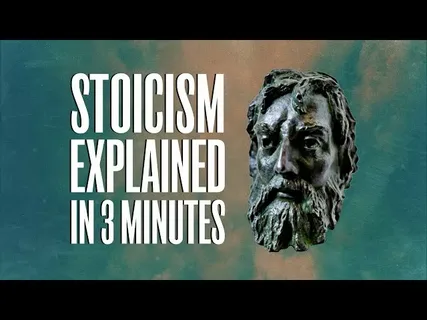
Of all the branches of philosophy that have survived from antiquity into modern self-help shelves, none has made quite the comeback that Stoicism has. Once the guiding framework for Roman emperors and enslaved teachers alike, Stoicism has resurfaced in boardrooms, therapy sessions, and bestselling books, promising a simple but demanding idea: peace of mind comes not from controlling the world, but from controlling yourself.
What Stoicism Actually Is
Stoicism began in Athens around 300 BCE, founded by a merchant named Zeno of Citium who, after losing his fortune in a shipwreck, turned to philosophy as a way of rebuilding a life he could actually rely on. The irony is fitting: a philosophy born from loss became one built entirely around resilience.
At its core, Stoicism rests on a single distinction that the philosopher Epictetus called the most important lesson a person could learn: some things are “up to us,” and some things are not. Our judgments, our desires, our reactions, our choices — these are ours to command. Our health, our reputation, the actions of others, the outcome of our efforts — these are not. Stoicism argues that nearly all human suffering comes from confusing the two categories: from trying to control what we cannot, and from neglecting what we actually can.
This is not resignation. It is not “shrugging off” hardship or pretending not to care. It is a redirection of energy away from anxious grasping at uncontrollable outcomes and toward the deliberate cultivation of character.
The Four Virtues
Stoic ethics organizes itself around four cardinal virtues, and unlike many philosophical systems, it treats these not as abstract ideals but as trainable skills:
Wisdom — the ability to judge situations clearly, without the distortion of panic, ego, or wishful thinking.
Courage — not the absence of fear, but the willingness to act rightly in spite of it, whether the danger is physical, social, or simply the discomfort of being wrong.
Justice — treating others with fairness and recognizing that human beings are, in the Stoic view, fundamentally social creatures bound to one another by reason and obligation.
Temperance — the discipline to moderate desire, to want the right things in the right amount, rather than being pulled around by every appetite or impulse.
For the Stoics, a good life wasn’t measured by wealth, health, or reputation — these were considered “indifferent,” not because they don’t matter at all, but because they are not up to us and therefore cannot be the foundation of a stable life. Only virtue, they argued, is truly good, because it is the one thing entirely within our own control.
Why It Refuses to Die
Stoicism’s most famous practitioners make an odd trio: Epictetus, a former slave; Seneca, a wealthy statesman and advisor to Emperor Nero; and Marcus Aurelius, the emperor of Rome itself. A philosophy that could speak equally to a man with no power and a man with nearly absolute power suggests something durable in its core insight — that inner freedom does not depend on outer circumstance.
That insight is likely why Stoicism has found new audiences among modern populations who would recognize almost nothing else about the Roman world: soldiers, athletes, executives, and ordinary people navigating anxiety in an age of information overload. The Stoic practice of distinguishing “what is mine to control” from “what is not” translates directly into modern language around focus, emotional regulation, and boundary-setting — concepts psychology would later formalize, but that Stoicism had already mapped out two thousand years earlier.
Cognitive behavioral therapy, in fact, owes a direct intellectual debt to Stoicism. Its founding insight — that it is not events themselves but our judgments about events that disturb us — is lifted almost verbatim from Epictetus’s Enchiridion. When a modern therapist asks a client to examine the story they’re telling themselves about a stressful event, they are, whether they know it or not, running a Stoic exercise.
The Practices, Not Just the Theory
Stoicism was never meant to be read passively. It came with a toolkit of practices meant to be rehearsed daily:
- Negative visualization — briefly imagining the loss of something valued (health, a relationship, a possession) not to invite despair, but to sharpen gratitude and reduce the shock of eventual loss.
- The view from above — mentally zooming out to see one’s problems from a vast, almost cosmic perspective, shrinking daily anxieties down to their true proportional size.
- Journaling — Marcus Aurelius’s Meditations was never intended for publication; it was a private nightly practice of self-examination, correction, and rehearsal for the day ahead.
- The dichotomy of control — a running mental audit, applied to any stressful situation, asking simply: is this within my power to change, or is it not?
These weren’t intellectual exercises for their own sake. They were maintenance routines for the mind, not unlike physical training for the body — repeated not because the insight was new each time, but because the mind forgets and needs re-training.
The Common Misreading
Modern pop-Stoicism sometimes flattens the philosophy into a kind of emotional armor — “don’t feel, don’t care, stay unbothered.” This is a misunderstanding the ancient Stoics would have firmly rejected. Seneca wept for lost friends. Marcus Aurelius, by his own private admission, struggled daily with irritation, distraction, and self-doubt. Stoicism was never about the absence of feeling; it was about not being ruled by feeling — about pausing long enough between event and reaction to choose a response worthy of one’s own values.
The goal was never a stiff upper lip. It was a settled one.
Why This Branch of Philosophy Still Matters
Most branches of philosophy ask us to think differently. Stoicism asks us to live differently — and it offers a method simple enough to try today: notice what is actually within your control, act well within that space, and let go, deliberately and repeatedly, of the rest. It is not a philosophy of detachment from life, but of full engagement with the only part of life we ever truly own — our own judgments, choices, and character.
Two thousand years after Zeno lost his cargo at sea, the shipwreck that started it all still holds a lesson: sometimes what looks like the end of the road is simply the place where a more durable kind of freedom begins.
