



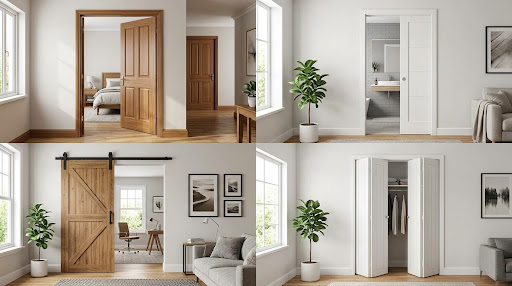
Most people don’t think about interior doors until something goes wrong. A door bangs into a dresser, blocks a hallway, or never quite closes on a cramped closet. These small frustrations usually trace back to one issue: the door style didn’t suit the space.
The good news is that there are more options than the classic hinged door, and each solves a different problem.
Start With How the Room Is Used
Before looking at finishes or hardware, consider a few practical questions:
- How much floor space is available around the opening?
- Does the room need sound privacy or just visual separation?
- Will the door stay open most of the day or closed?
- Is natural light from one room worth sharing with another?
Your answers will narrow the choices quickly.
Swing Doors: The Reliable Classic
Hinged swing doors remain the most common option for good reason. They seal well, offer strong privacy, and work in nearly any room. Bedrooms, bathrooms, and home offices usually benefit from this style.
The trade-off is clearance. A swing door needs an empty arc of floor space, which can be awkward in narrow hallways or small rooms.
Pocket Doors: Saving Space Without Losing Style
Pocket doors slide into a cavity inside the wall, disappearing completely when open. They’re ideal for tight areas like laundry rooms, pantries, or small bathrooms where a swinging door would get in the way.
What to Keep in Mind
Installing a pocket door usually requires opening up the wall, so it’s easier during a renovation than as a quick update. Electrical outlets or plumbing in that section of wall may also need to be relocated.
Barn Doors: A Visible Design Feature
Sliding barn doors hang on an exposed track and glide along the wall. They add character and work well in living areas, home offices, or anywhere you want the door itself to be part of the decor.
They don’t seal as tightly as swing doors, so they’re better suited to spaces where complete sound privacy isn’t essential.
Bypass and Bi-Fold Doors: Closet Solutions
Bypass Doors
Bypass doors use two or more panels that slide past each other on parallel tracks. They’re common on wide closets and are easy to operate, though only part of the closet is accessible at once.
Bi-Fold Doors
Bi-fold doors fold in on themselves, opening up nearly the full width of a closet. They need less clearance than a swing door and give better access than bypass panels.
Glass, Solid, or Somewhere in Between
Once you’ve picked a style, the panel itself matters. Solid wood offers privacy and a sense of weight. Clear glass shares light between rooms. Frosted or opaque glass sits in the middle, letting light pass while blurring what’s behind it.
If you’re aiming for a cohesive look across the house, Custom Modern Doors can be sized and finished to fit unusual openings while keeping a consistent design language from room to room.
Thinking Beyond the Door Itself
Doors rarely work in isolation. Their placement affects how light from nearby openings reaches the room, and how furniture can be arranged around focal points. When planning a larger update that also involves Windows and Fireplaces, it’s worth sketching the full layout first so every element supports the others.
Getting Installation Right
Sliding systems, in particular, depend on precise installation. A track that’s slightly off level can cause doors to drift or stick. For wall modifications or structural changes, connecting with Premium Home Improvement Professionals such as door installers or general contractors can save time and prevent problems later.
Final Thoughts
The right interior door is the one you stop noticing because it simply works. Match the style to the room’s purpose, consider the space around the opening, and choose materials that fit the rest of your home. Small decisions like these add up to a house that feels easier to live in every day.
